Welcome to The Odyssey Controversies, the discourse event of summer 2026, in which a Viking ship, a Batman cosplay, the word “dad,” and Elon Musk’s Twitter account all conspired to convince people that Christopher Nolan doesn’t know how to read a book he clearly read very closely.
Christopher Nolan spent three decades building a reputation as the guy who bends time, blows up buildings for real, and refuses to let anyone watch his movies on a phone.
Then he announced he was adapting Homer’s Odyssey — a 2,700-year-old poem about a man who takes ten years to drive home from work — and the internet responded the way the internet responds to literally everything now: with a controversy so large it needed its own subplot.
Below is the full breakdown of The Odyssey Controversies — what happened, who yelled, why they were (mostly, hilariously) wrong, and where you can go read the original reporting yourself instead of trusting a guy on X who thinks Homer wrote in iambic pentameter.
Chapter One: The Casting “Controversy” That Launched a Thousand Quote-Tweets
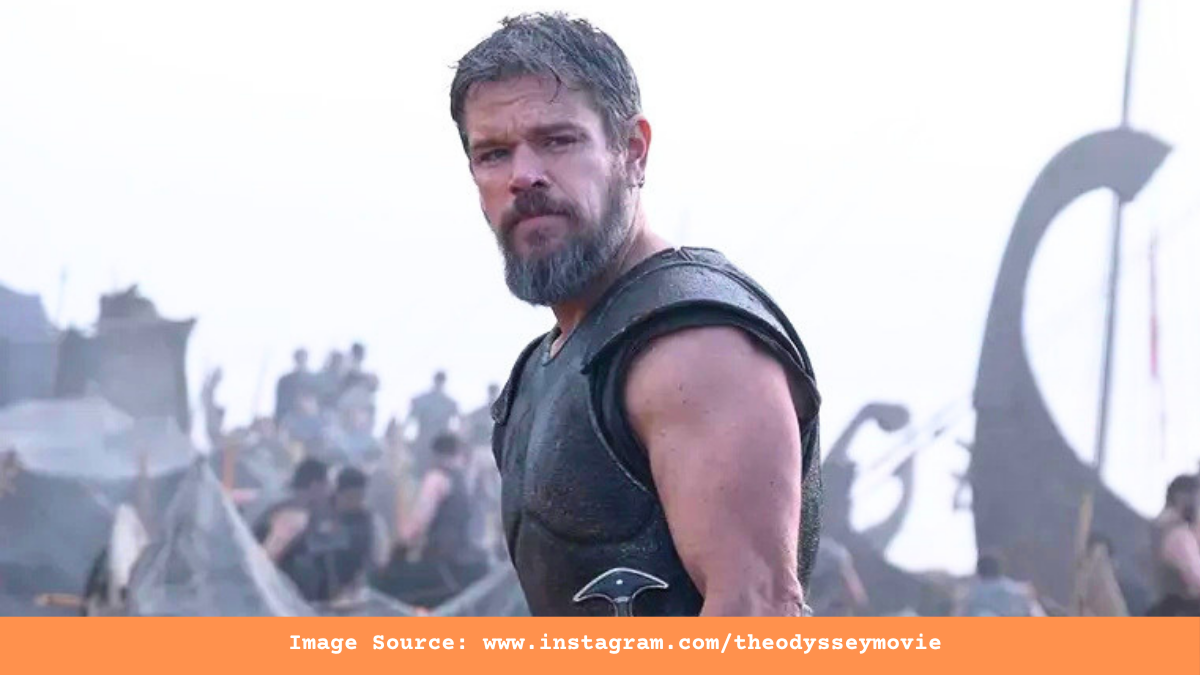
No rundown of The Odyssey Controversies can begin anywhere except here, because this is where the internet’s brain actually broke. Nolan built himself an absurd ensemble — Matt Damon as Odysseus, Anne Hathaway as Penelope, Tom Holland as Telemachus, Zendaya as Athena, Robert Pattinson as Antinous, Charlize Theron as Calypso — and then cast Lupita Nyong’o in the dual role of Helen of Troy and Clytemnestra, and Elliot Page as Sinon, the cousin of Odysseus. According to Fox News, this immediately produced a wave of backlash over “historical accuracy,” with online commentators insisting Homer’s Helen was described as fair-skinned and blonde, and that casting an Oscar-winning Kenyan-Mexican actress was somehow an affront to a poem composed by a blind bard who never met a color he didn’t mythologize into something metaphorical.
Elon Musk, never one to let a Tuesday pass without an opinion he hasn’t fully thought through, weighed in directly. Per reporting from AOL/ComingSoon.net, Musk posted that “Chris Nolan has lost his integrity” in response to a user calling the Nyong’o casting “an insult to the author.” Never mind that Homer isn’t around to feel insulted, has no known legal standing, and — being an oral tradition possibly assembled by multiple poets over centuries — may not have actually existed as a single author in the first place. This is the level of scholarly rigor The Odyssey Controversies operated on.
The backlash escalated further when co-hosts of The View publicly pushed back on Musk and other conservative commentators for criticizing the diverse casting, as detailed by OutKick/Fox News, which also reported that the film’s final trailer had racked up over 542,000 dislikes. Somewhere in the middle of all this, Nyong’o herself gave an interview noting that if she watched the finished film, she’d want to ask Homer why the original poem had so little female representation — a genuinely fair question to lob at a three-thousand-year-old text, and one that got noticeably less coverage than Musk’s four-word tweet.
Here’s the case for why this branch of The Odyssey Controversies was mostly noise: Homer’s Odyssey is a poem, not a police sketch. It was composed centuries before anyone wrote down consistent physical descriptions of any character, transmitted orally for generations, translated hundreds of times into dozens of languages, and adapted on stage and screen more times than anyone has bothered to count. There is no canonical Helen. There has never been a canonical Helen. Demanding textual purity from a story whose oldest surviving manuscripts are themselves copies of copies of an oral performance is not scholarship — it’s cosplay judging.
Chapter Two: The Viking Ship That Sailed Two Thousand Years Too Early
Next on the The Odyssey Controversies hit list: boats. Specifically, a shot in the trailer featuring the Draken Harald Hårfagre, a modern recreation of a medieval Viking longship, doing service as one of Odysseus’s vessels. According to Britannica’s breakdown of the film’s reception, audiences noticed that this style of ship wouldn’t have existed until roughly two millennia after the events the Odyssey describes, and social media proceeded to treat this the way historians treat forged papyrus.
This is, respectfully, an enormous swing at a very small ball. Nolan is famous for insisting on practical builds and real, sailable ships rather than a green-screen ocean, which meant working with what large-scale seaworthy vessels currently exist in the world rather than commissioning a Bronze Age penteconter from scratch and hoping it doesn’t sink an Oscar-winner. Every filmed version of the Odyssey ever made — going back to 1954’s Ulysses with Kirk Douglas — has taken liberties with ship design, weaponry, and armor, because nobody has a surviving 8th-century-BC shipyard to reference and because “period accurate to a poem about a war that may or may not have literally happened” is not a genre with a strict style guide.
Chapter Three: Agamemnon’s Armor, or, “Did Batman Design This?”
Costume design is the next front in The Odyssey Controversies, and it’s the one with the best jokes. Per HuffPost’s rundown, viewers zeroed in on Benny Safdie’s armor as Agamemnon, arguing it looked suspiciously like Batman’s cowl and cape, with one commenter asking, essentially, since when did Ancient Greeks source their battle gear from Wayne Enterprises. Another, slightly more self-aware commenter cut through the fake-historian routine entirely, admitting the real complaint wasn’t accuracy at all — the costumes just looked, in their words, boring.
This is honestly the most honest moment in the entire saga of The Odyssey Controversies: a brief flash of a critic admitting their actual aesthetic opinion instead of dressing it up as archaeology. And fair enough — armor design is a legitimate thing to have a take on! But “this looks like Batman” is not evidence of historical negligence; it’s evidence that Christopher Nolan directed three Batman movies and, as an artist, apparently has a recognizable visual signature. Asking him to abandon his own instincts because they’re recognizable is like asking Wes Anderson to stop using symmetry.
Chapter Four: Telemachus Calls His Dad “Dad”
Somewhere in the marketing cycle, a clip surfaced of Tom Holland’s Telemachus referring to Odysseus as “dad.” Fox News reported this as one of the flashpoints of modern-dialogue criticism, with one X user calling it “the most egregious problem” of the whole production — more egregious, apparently, than the casting discourse, the ship discourse, or the armor discourse combined.
The case for the defense writes itself: the entire Odyssey has been translated into contemporary English for a hundred and fifty years, because that’s what translation is. Emily Wilson’s celebrated 2018 translation — the first ever published by a woman, as noted by the New York Times and cited in HuffPost’s coverage — rendered the poem in plain, contemporary language specifically to strip away centuries of stuffy, faux-archaic diction that had calcified around the text and made it feel more distant than it was ever meant to feel. Homer’s original audience wasn’t listening to a poem in a dead, formal register; they were hearing it in their own living vernacular, performed live, at parties. A kid calling his father “dad” is, if anything, closer to the spirit of the original oral tradition than a kid calling him “esteemed progenitor” would be.
Chapter Five: Screenings, Snafus, and Other Things That Weren’t Actually Controversies
Not every headline attached to The Odyssey Controversies turned out to be a real controversy at all. Reports circulated about canceled screenings amid the casting backlash, but the more substantiated, less breathless story — covered by Variety — was about ticket-buying demand vastly outstripping app capacity, with the AMC ticketing app reportedly leaving moviegoers waiting up to an hour to buy tickets and Fandango’s site experiencing its own lag. That’s not a controversy. That’s a hit.
The Verdict: What Actually Happened When People Saw the Movie
Here’s the part of The Odyssey Controversies that the discourse machine conveniently skipped over: the reviews came in, and they were spectacular. According to The Hollywood Reporter, the film opened to a 98% critics score on Rotten Tomatoes, the highest of Nolan’s career, shot entirely on IMAX 70mm film for the first time ever attempted on a feature. Rotten Tomatoes’ own editorial roundup collected critics calling it one of the greatest epic fantasy films ever made, praising performances across a cast that also includes Jon Bernthal, Samantha Morton, Mia Goth, and Bill Irwin. Early reactions gathered by Deadline and ScreenRant described it as “staggering,” a possible Best Picture frontrunner, and — from ScreenRant’s own review — “the must-see theatrical experience of our generation.” Not every single reaction was a rave; Time’s review pushed back specifically on the Nyong’o casting discourse, arguing it read less like bold reinvention and more like a missed opportunity — a genuinely substantive critique, and notably not one about Viking ships or Batman armor.
Nolan himself addressed the swirl of pre-release noise directly. Speaking to The Telegraph and reported by Deadline, he pointed out that this exact cycle happened to him before, on a little trilogy called The Dark Knight, and that pre-release discourse about adaptations is functionally worthless because nobody arguing about it has actually seen the finished film. He noted that fans of a beloved property tend to come around once they see a sincere, well-crafted attempt on screen — even one that isn’t the version they’d have made themselves. Which is, it turns out, exactly what happened here.
So Were The Odyssey Controversies Actually Founded?
Taking the full sweep of The Odyssey Controversies together — the casting objections, the ship anachronism, the armor comparisons, the “dad” complaint — the throughline is remarkably consistent: nearly every single complaint was lodged against a trailer, a rumor, or a leaked photo, by people who had not yet watched a single frame of context, dialogue, or performance. That’s not unique to this movie; it’s the default operating mode of modern film discourse, where the pre-release outrage cycle has become a genre unto itself, running on a completely separate track from the actual quality of the finished work. Homer’s Odyssey has survived translation into dozens of languages, hundreds of adaptations, several thousand years, and at least one animated Disney-adjacent musical number, precisely because it isn’t a fragile artifact that shatters on contact with a Kenyan actress or a modern verb tense — it’s a story sturdy enough to be retold endlessly, which is the entire reason Nolan wanted to retell it in the first place.
By the time actual critics with actual eyeballs got into actual theaters, The Odyssey Controversies quietly evaporated into a 98% Rotten Tomatoes score, a director politely declining to engage with people who hadn’t seen his movie, and a ticketing app that couldn’t keep up with demand. Sometimes the discourse just needs to sail home and see what’s actually waiting at the door.
Keep coming back to ScreenTrak for the latest in the world of entertainment!
Sources cited in this article:
- Britannica — Controversies About Christopher Nolan’s The Odyssey, Explained
- HuffPost — Christopher Nolan’s ‘The Odyssey’: Every Controversy Explained
- Fox News — Christopher Nolan faces backlash over ‘The Odyssey’ casting choices
- OutKick/Fox News — ‘The Odyssey’ gets overwhelmingly negative reactions
- Deadline — Christopher Nolan Dismisses ‘The Odyssey’ Casting Backlash
- AOL/ComingSoon.net — Elon Musk Blasts Christopher Nolan’s ‘Integrity’ Amid The Odyssey Rumors
- The Hollywood Reporter — ‘The Odyssey’ Reviews Roundup
- Deadline — ‘The Odyssey’: First Reactions From The Critics And Fanboys
- Variety — The Odyssey First Reactions Go Wild for Christopher Nolan Epic
- ScreenRant — The Odyssey Reactions Are Officially In
- Rotten Tomatoes — The Odyssey First Reviews
- Time — ‘The Odyssey’ Is Just Another Reason for Despair