
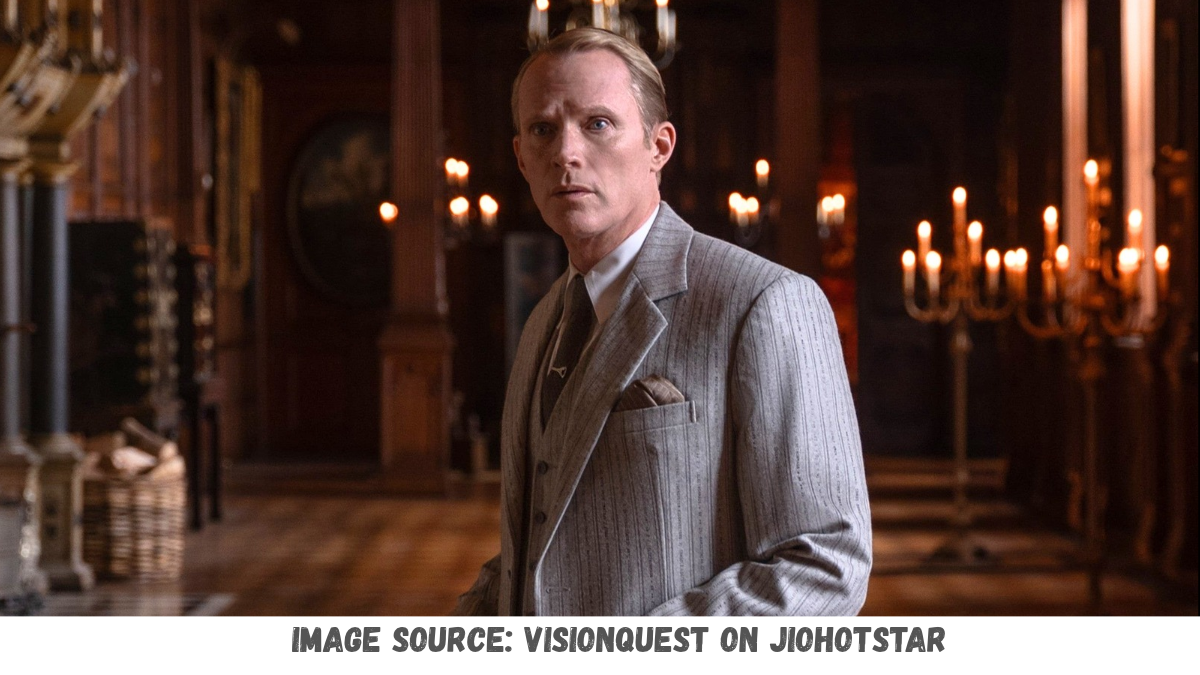
A psychology-focused analysis of Marvel Television’s VisionQuest, Season 1, Episode 7
This VisionQuest Episode 7 breakdown looks past the plot mechanics of “Immolation” — the Disney+ series’ penultimate hour, which streamed November 3, 2026 — to the clinical and theoretical psychology quietly doing the heavy lifting underneath it.
Marvel Television’s VisionQuest has spent its first six episodes framing Vision (Paul Bettany) as an android carrying Wanda Maximoff’s memories without the feelings attached to them, a condition showrunner Terry Matalas has described as a kind of blank slate, comparable, in his telling, to Spock’s emotional reconstruction in Star Trek IV: The Voyage Home. “Immolation” is the hour where that blank slate finally fills in, and it does so using a coherent set of real psychological principles: denial, dissociation, intergenerational trauma, attachment rupture, cognitive dissonance, projection, and identity integration.
What follows is a full VisionQuest Episode 7 breakdown of each mechanism, grounded in what critics, recappers, and the people who made the episode have said about it.
1. Denial as the Engine of the Character (Kübler-Ross’s Stages of Grief)
The clearest psychological throughline of this VisionQuest Episode 7 breakdown is denial, the first stage in Elisabeth Kübler-Ross’s five-stage model of grief (denial, anger, bargaining, depression, and acceptance), originally developed to describe how the terminally ill process dying and later broadened into general grief theory.
TellTaleTV’s review of the episode makes this connection explicit, arguing that the series has circled the denial stage for most of its run and that Vision’s repeated insistence that he is “a different version” of himself is actually a symptom of unprocessed grief rather than a neutral fact about his identity. In clinical terms, denial functions as a defense mechanism that lets a person, or here a synthetic person, avoid the destabilizing weight of loss by refusing to integrate it into their self-concept.
“Immolation” is structured as the episode that finally collapses that defense, which is why multiple outlets single it out as the show’s emotional turning point.
Also Read: VisionQuest Episode 7″Immolation”: A Complete Plot Rundown, Breakdown and Analysis
2. Dissociation and Psychological Splitting
A second principle at the center of this VisionQuest Episode 7 breakdown is dissociative splitting, the mind’s habit of separating an overwhelming experience, or an entire self, into compartments that don’t have to touch each other. Fangirlish’s review describes Vision’s arc in nearly textbook terms: the disconnect he felt between his memories and his feelings wasn’t a factual gap, it was a protective split, a mental wall built so he wouldn’t have to feel the loss underneath it.
The episode literalizes this defense mechanism by sending Vision into his own code to confront separate versions of himself, including the original Vision, the corrupted White Vision, and J.I.M., the burning prototype built by Phineas Horton, each one a dissociated fragment carrying a different piece of the same unprocessed history.
Altbollywood’s breakdown of the episode frames this as a structural choice: Wanda’s refusal to grieve produced White Vision, and Vision’s own refusal to grieve produced the version of himself the audience has watched all season, with both constructs described as carrying the cost of grief that was never faced.
3. Intergenerational Trauma Transmission
Where this VisionQuest Episode 7 breakdown gets unusually sophisticated is in how it maps intergenerational trauma transmission, the phenomenon by which unresolved grief or dysfunction in one generation shapes the emotional patterning of the next. The episode’s 1939 cold open establishes Phineas Horton, also played by Bettany, building J.I.M. after his son’s death, unable to let the loss go even as his wife hopes he might build something capable of loving him back, per the recap from Fiction Horizon.
A review from News Beep draws the parallel directly: Phineas is so burdened by grief that he externalizes it into a physical, man-on-fire painting rather than face it, a form of projective displacement comparable to how Wanda’s own grief later “destroyed her sanity and her morality,” in the outlet’s words, and ultimately points back at Vision himself.
The chain is unbroken grief passed down a synthetic family line, from Horton to J.I.M., from Ultron’s rage to the Vision he helped assemble, from Wanda’s denial to White Vision, and “Immolation” is the episode that finally asks Vision to be the generation that breaks the pattern instead of repeating it.
4. Attachment Theory and the Rupture-and-Repair Cycle
Attachment theory, which describes how early bonds shape a person’s capacity to trust, depend on, and emotionally regulate with others, runs underneath the Vision-Tommy relationship for the entire hour.
According to The Film Gordon’s recap, Tommy’s panic over possibly losing Lisa Molinari to Jocasta’s nanobot brings him closer to understanding his mother Wanda’s grief, with Tommy admitting that losing someone he loves would feel like losing himself, a description that matches what attachment researchers call an anxious or enmeshed response to threatened loss.
This VisionQuest Episode 7 breakdown reads the episode’s closing act, in which Vision stops calling his son “Thomas” and starts calling him “Tommy,” as a textbook attachment repair: the rupture, Vision’s emotional withdrawal and refusal to claim parentage, is followed by reunion and acknowledgment, the two halves of what attachment theorists call the rupture-and-repair cycle that strengthens rather than damages a bond once it is completed.
5. Cognitive Dissonance and the Client’s Bargain
The mysterious Client’s offer to Vision, described in the episode’s own transcript as the ability to give Vision “the soul you came back to life without,” dramatizes cognitive dissonance, the discomfort that arises from holding two incompatible beliefs or desires at once. Vision wants to feel what it is like to be “him,” the original pre-Infinity War Vision, while simultaneously knowing, on some level, that he isn’t that person and cannot simply reclaim an old identity wholesale.
Looper’s coverage of the episode’s final twist, confirming that the Client is Ultron (James Spader) operating behind a shadowy avatar, reframes the entire bargain as manipulation that exploits this dissonance: Ultron offers resolution to a conflict he engineered in the first place, which mirrors how cognitive dissonance can be weaponized by someone who benefits from a person staying unresolved and dependent on an outside answer rather than resolving the conflict internally.
6. The Jungian Shadow and Multiple Selves
Carl Jung’s concept of the shadow, the disowned and often painful parts of the self that a person pushes out of conscious awareness, maps unusually well onto Bettany’s four-role performance in this episode.
Absolute Geeks’ review calls out the achievement directly: four distinct versions of one actor, each representing a different relationship to the same unresolved grief, with White Vision in particular finally allowed to crack open and release everything the character has suppressed.
In Jungian terms, confronting the shadow is necessary for individuation, the lifelong process of integrating disowned parts of the self into a coherent whole.
Comic Basics’ recap of the ending notes that White Vision’s reaction to being told the truth is not relief but violence, destroying the version of Vision that is trying to integrate, a fairly literal dramatization of how the shadow resists acknowledgment even when confrontation is the only path to psychological wholeness.
7. Narrative Identity Theory and the WandaVision Tapes
Psychologist Dan McAdams’s narrative identity theory holds that people construct a sense of self by building an internal, evolving story out of their remembered past, and that psychological health depends on integrating difficult chapters into that story rather than editing them out.
“Immolation” stages this almost literally: per Altbollywood’s breakdown, Vision leaves Tommy the original S.W.O.R.D. recordings of WandaVision, his mother’s grief on display, as Vision puts it in the episode’s own transcript, so Tommy can know the mother and brother he lost.
Handing over that footage is simultaneously a plot device and a psychological one: Vision consciously restores a suppressed chapter to the family’s shared narrative identity instead of continuing to keep it walled off, which TellTaleTV frames as proof that this is the most fully realized Vision has ever felt by the episode’s end.
8. Identity Status and the Line “I Have Always Been the Vision”
Psychologist James Marcia’s identity status theory describes a spectrum running from identity diffusion, with no sense of commitment or exploration, through moratorium and foreclosure, to identity achievement, in which a person has explored the available options and arrived at a self-definition they can commit to. For six episodes, Vision has operated in something close to diffusion, treating his own identity as contested or borrowed.
The turning point of this VisionQuest Episode 7 breakdown, and arguably of the whole series, is the line delivered inside Vision’s own mindscape: “I am the Vision. I have always been the Vision,” as recorded in the episode transcript and highlighted by both Fangirlish and Comic Basics as the hour’s thesis statement.
That is identity achievement rendered as dialogue: Vision stops auditioning competing versions of himself and commits, out loud, to being the sum of all of them, Ultron’s component and Wanda’s component, sons included.
What the Cast and Crew Have Said
The people behind the show have been fairly direct about building “Immolation” around psychology rather than spectacle. Showrunner Terry Matalas, previously known for Star Trek: Picard, visibly drew on Star Trek: The Next Generation’s android-family episodes for the structure of this hour, according to Nerdist’s analysis of the episode’s Trek influences, casting Bettany as creator, flawed prototype, and finished product within a single family tree much like Data and his creators in that franchise.
Bettany himself told outlets covering the episode that he was thrilled to bring a satisfying ending to the WandaVision trilogy, and separately described James Spader’s dual performance as Ultron and the Client as “delicious” to play against, per Comic Basics’ recap of the finale setup.
The Ringer’s House of R podcast devoted a full deep-dive episode to “Immolation” on the day it aired, followed by an extended interview with Bettany about shaping Vision’s arc and his multiple looks across the season, further evidence that the episode’s psychological ambitions registered with outlets covering the show as much as its action set pieces did.
The Verdict of This VisionQuest Episode 7 Breakdown
Across every outlet referenced in this VisionQuest Episode 7 breakdown, one idea recurs in different forms: you cannot skip grief. Phineas tried, and built a burning machine. Wanda tried, and built White Vision. Vision tried, and spent six episodes insisting he was someone else.
“Immolation,” a title that means both destruction by fire and sacrifice, as Altbollywood’s explainer notes, resolves that pattern not through a bigger fight but through a more complete act of psychological integration: denial gives way to acknowledgment, dissociated selves are reunited, a withheld narrative is handed back to the person who needs it, and a diffused identity is finally, deliberately claimed.
That is the real engine of this VisionQuest Episode 7 breakdown, and it is very likely why critics have called this the show’s highest-rated and most ambitious hour to date.
Publications Referenced in This VisionQuest Episode 7 Breakdown
- TVLine — Marvel’s VisionQuest Episode 7 Features A Crucial Connection To Avengers: Infinity War
- TellTaleTV — VisionQuest Season 1 Episode 7, “Immolation,” Review: Vision Finally Confronts His Grief
- Looper — Marvel’s VisionQuest Finally Reveals The Identity Of Its Main Villain
- BamSmackPow — Marvel’s VisionQuest episode 7 is coming out sooner than announced
- Forbes — VisionQuest Episode 7 Release Date And Preview: Ultron’s Endgame Is Coming Into Focus
- Fiction Horizon — VisionQuest Episode 7 Recap and Ending Explained: The Client Finally Steps Into View
- Fangirlish — Vision Quest Episode 7 Review: “Immolation” Brings Vision Back, Once Again
- The Film Gordon — VisionQuest S1 E7 Recap: 7 Shocking Revelations
- Altbollywood — VisionQuest Episode 7 ‘Immolation’ Explained: Phineas Horton, the Human Torch and That Final Reveal
- Comic Basics — ‘VisionQuest’ Episode 7 Recap and Ending Explained: The Client Wears Ultron’s Face
- Comic Basics — ‘VisionQuest’ Episode 7 Release Date, Time and Where to Watch the Penultimate Episode
- News Beep — ‘VisionQuest’ Recap, Episode 7: ‘Immolation’
- Absolute Geeks — VisionQuest episode 7 review: Marvel just made its creepiest Disney+ episode yet
- Nerdist — The Many STAR TREK Inspirations in VISIONQUEST Episode 7
- The Ringer — ‘VisionQuest’ Episode 7 Deep Dive. Plus, Paul Bettany!
- Episode Magazine — ‘VisionQuest’ – Interview with Terry Matalas, Paul Bettany and James Spader
- TV Show Transcripts — s01e07 “Immolation” VisionQuest Transcript
- Wikipedia — Five Stages of Grief (Kübler-Ross Model)



One thought on “VisionQuest Episode 7 Breakdown: The Psychology of Grief, Identity, and the Many Faces of Vision in “Immolation””