
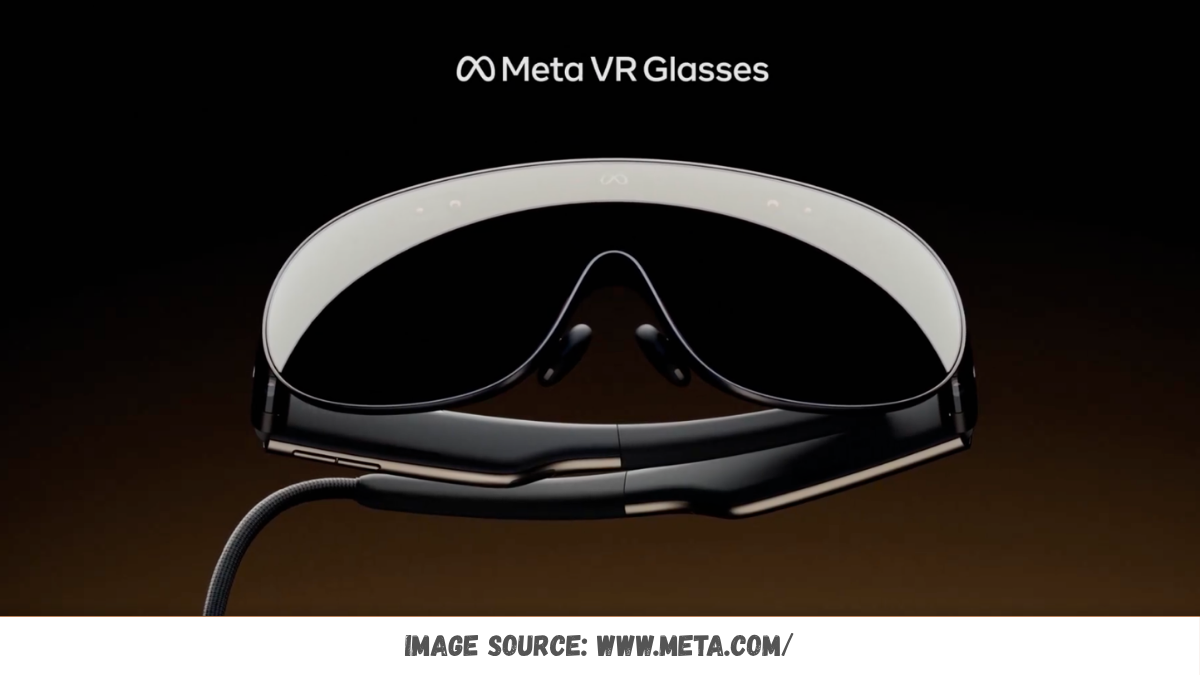
Meta VR Glasses are here, they cost more than a decent used car down payment, and somehow they still made half the internet gasp like they’d just seen a magic trick.
At Meta Connect 2026, Mark Zuckerberg strolled onto a stage and did the thing Silicon Valley loves most: took a chunky box that used to sit on your head and shrank it into something that looks — almost, nearly, if you squint in dim lighting — like normal eyewear.
The result is a product literally named “Meta VR Glasses,” because apparently Meta’s naming department clocked out early and just described the product instead of branding it.
So What Actually Got Unveiled?
Let’s get the vitals out of the way first, because the numbers here are genuinely wild. According to Meta’s own announcement at Connect, the new VR glasses were priced at $1,299 and pitched as an upgraded evolution of the Quest headset line.
Zuckerberg himself leaned into the drama, declaring that the company had built a new kind of VR device delivering the same feeling of presence and immersion as a full headset, but in a genuine glasses form factor for the first time.
Chief Technology Officer Andrew Bosworth, never one to undersell things, told the crowd you basically get a private cinema, a game console, and a computer, all packed into the “sexiest pair of VR glasses” he’s ever seen. Humble guy, Boz.
Here’s the part that actually makes the marketing hyperbole believable: the weight. Meta says its VR glasses come in at around 100 grams — roughly five times lighter than the Meta Quest 3 headset. That’s the whole magic trick.
Meta achieved this by splitting the device in two: the glasses handle sensors and the display, while a separate “puck” handles the heavy lifting, tethered to your face by a cable, like a very expensive, very nerdy fanny pack for your eyeballs.
That puck reportedly packs 12GB of RAM and 128GB of storage, with a microSD slot for extra space — so yes, your VR glasses may end up with more onboard storage than your first laptop.
On the optics side, Meta went all in. The glasses use a 5K Infinite Display built on micro-OLED panels at 37 pixels per degree, and feature dual 120Hz 2412×2288 HDR micro-OLED panels — the highest resolution of any Meta headset yet, and the company’s first non-LCD headset since the original Oculus Quest back in 2019.
It’s also, notably, the first IMAX Enhanced certified VR device, and it runs on Qualcomm’s new Snapdragon Reality Elite processor. Somewhere, an engineer is very proud of a chip name that sounds like a energy drink.
The Open-Periphery Trick
The strangest and most clever part of the design is arguably the field of view. Meta VR Glasses use an open-periphery design, meaning you can naturally see the real world at your sides and below you, rather than being fully sealed into a headset bubble.
You can attach optional “light blockers” if you want the classic fully-immersive VR experience, but — and this is a genuinely funny irony for a product called VR Glasses — reviewers noted the device actually shines more in passthrough mixed reality mode without the blockers, since a natural view of your surroundings often beats total darkness. So the “VR” glasses might end up being best known for barely doing VR at all. Beautiful.
For comparison’s sake, one hands-on breakdown pointed out that the core proposition is similar to Xreal’s Aura Android XR device, but with a VR-style passthrough system offering a wider ~87° diagonal field of view versus Xreal’s 70°, higher resolution, full opacity, plus eye tracking and optional tracked controllers. So Meta didn’t invent the category — it just showed up with a bigger engine and a fancier badge.
Also Read: Apple Watch Series 12 First Impressions: A Very Fashionable Wrist Is Now Legally Complicated
What You’ll Actually Do With Them
Beyond staring in wonder at your own reflection in a mirror while wearing them, Meta has entertainment and productivity ambitions stacked up. At launch, Meta VR Glasses will support VR-enhanced versions of films like Avengers: Infinity War and Star Wars: A New Hope through a new Disney Immersive Cinema by ILM app, and the company plans over 100 immersive live sports broadcasts a year through partners including MLB, NBC Sports, TNT Sports, and UFC.
Somewhere a couch potato is quietly weeping with joy.
There’s a productivity pitch too, because nothing says “get in the zone” like a puck cable dangling off your face. True to its metaverse-derived name, Meta is positioning the glasses as a serious tool for productivity, and like Apple’s Vision Pro, they’ll support holographic avatars for video calls on apps like WhatsApp and Zoom, complete with spatial audio that places a caller’s voice at the location of their hologram.
Naturally, Meta AI is baked in too, so you can just talk to the glasses to get things done, which is either the future of computing or the beginning of everyone talking to themselves in public, depending on your priors.
Gamers aren’t forgotten either — the glasses will run the full existing Quest game library, aided by support for Touch Plus controllers, and Beat Saber is getting its biggest update yet alongside a wave of new entertainment content.
Meta also confirmed the glasses run the same operating system, store, and SDKs developers already use for Quest, releasing the v207 SDK immediately so studios can start building day one, even though the hardware itself won’t ship until spring 2027. Interaction is primarily eye- and hand-based, with controllers supported but expected to go mostly unused by most customers — a bold bet that we’ve all secretly wanted to stop clutching plastic wands since 2016.
Battery life, meanwhile, is refreshingly honest for once: Meta says the glasses deliver “up to three hours of continuous high-resolution media playback” on a charge. Which is, generously, one long-haul flight’s worth of Star Wars before the puck taps out.
The Price Tag Problem (Because There’s Always One)
Every Meta VR Glasses story eventually collides with the number $1,299, and the internet’s reaction has been exactly what you’d expect: equal parts “shut up and take my money” and “absolutely not, I’m not spending a used-car down payment on eyewear.” It’s a pattern Meta knows well — the company has a long history of headsets launching at eyebrow-raising prices before eventually trickling down into cheaper models, the way the original Quest Pro debuted north of $1,500 before settling into a more modest niche.
Expect the same arc here: a halo product for early adopters and developers, with a cheaper “Quest”-branded sibling almost certainly waiting in the wings a generation or two later.
It’s also worth noting the timing isn’t accidental. Meta has spent years positioning itself as the “affordable” alternative to Apple’s $3,499 Vision Pro, so pricing its own glasses at well under half that number, while still hitting IMAX-certified, 5K-panel specs, is as much a message to Cupertino as it is a product launch.
Should You Buy Meta VR Glasses?
Honestly? Not yet — you can’t, they don’t ship until spring 2027, so for now all anyone can do is admire the trailer and argue about the price in the comments section. But the direction is clear: Meta VR Glasses represent the company’s clearest bet yet that virtual reality’s future isn’t a bulky headset bolted to your skull, it’s something you can plausibly wear to the airport without a stranger asking if you’re filming a sci-fi movie.
Whether $1,299 buys you the future of computing or just a very elaborate way to watch Star Wars on a plane, Meta VR Glasses have, at minimum, successfully gotten everyone talking — which, for a company that’s spent years trying to convince the world the metaverse is real, might be the biggest win of the night.
Sources referenced in this piece:
- UploadVR — “Meta VR Glasses Officially Announced, Shipping Spring 2027 For $1300”
- GSMArena — “Meta announces new VR Glasses and camera-free Ray-Ban Meta Audio”
- Engadget — “Everything announced at Meta Connect 2026”
- Meta Developers Blog — “VR is Expanding. Start Building for Meta VR Glasses Today.”
- Variety — “Meta Unveils VR Glasses for $1,299, Promises 3D Films from Studios”
- Meta.com — “Introducing Meta VR Glasses, A New Era for Virtual Reality”




One thought on “Meta VR Glasses Just Landed, and Your Face Will Never Be the Same”